
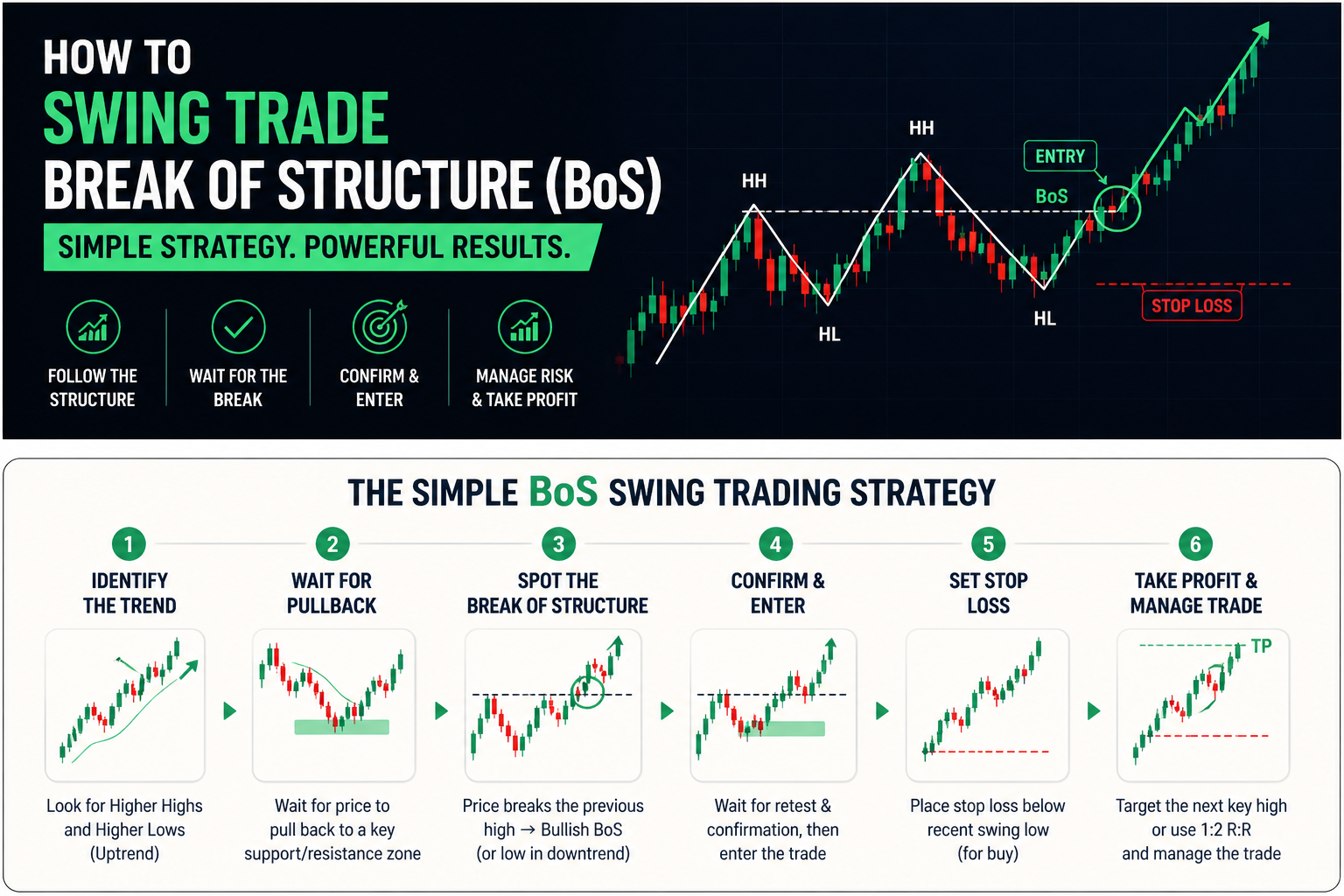
Swing trading doesn’t have to be complicated. In fact, some of the most effective strategies are built on simple market principles—and one of the most powerful among them is the Break of Structure (BoS).
In this guide, you’ll learn how to identify, confirm, and trade BoS in a clean and structured way—perfect for traders who want clarity, precision, and consistency.
What is Break of Structure (BoS)?
Break of Structure (BoS) refers to a clear violation of a previous market high or low, signaling a potential shift or continuation in market direction.
- Bullish BoS: Price breaks above a previous swing high
- Bearish BoS: Price breaks below a previous swing low
This concept helps traders understand market flow, which is essential for swing trading.
Why BoS Matters in Swing Trading
Swing trading focuses on capturing medium-term price moves. BoS helps you:
- Identify trend continuation or reversal
- Avoid random entries
- Trade with market structure instead of emotions
- Improve risk-to-reward setups
Simply put, BoS gives you a logical framework to follow price action.
Market Structure Basics (Before Using BoS)
To trade BoS effectively, you must understand basic structure:
- Uptrend: Higher Highs (HH) and Higher Lows (HL)
- Downtrend: Lower Highs (LH) and Lower Lows (LL)
A Break of Structure confirms whether this pattern is continuing or changing.
The Simple BoS Swing Trading Strategy
Let’s break it down step by step.
Step 1: Identify the Trend
Start with a higher timeframe (H4 or Daily):
- Look for clear HH and HL (uptrend)
- Or LH and LL (downtrend)
Trade in the direction of the trend for higher probability.
Step 2: Wait for a Pullback
Never chase price.
- In an uptrend → wait for price to pull back to a support area
- In a downtrend → wait for a pullback to resistance
This gives you better entry and lower risk.
Step 3: Spot the Break of Structure
Now comes the key moment:
- In an uptrend → price breaks previous high → Bullish BoS
- In a downtrend → price breaks previous low → Bearish BoS
This confirms that the trend is continuing.
Step 4: Entry Strategy
There are two simple entry methods:
Option A: Immediate Entry
Enter right after the breakout candle closes.
Option B: Retest Entry (Recommended)
Wait for price to return (retest) the broken structure level.
- Enter after confirmation (e.g., rejection candle)
- This improves accuracy and reduces false breakouts
Step 5: Stop Loss Placement
Always protect your capital.
- For Buy → below the recent swing low
- For Sell → above the recent swing high
Keep it logical, not emotional.
Step 6: Take Profit Strategy
Use structure again:
- Target the next key high/low
- Or aim for a minimum 1:2 risk-to-reward ratio
You can also trail your stop to lock profits.
Example of a BoS Trade (Conceptual)
Bullish Scenario:
- Market forms higher highs and higher lows
- Price pulls back to a support zone
- Price breaks previous high → BoS confirmed
- Price retests the level
- Entry triggered on bullish confirmation
- Target next resistance
This simple flow is repeatable and effective.
Common Mistakes to Avoid
Even simple strategies fail if misused. Watch out for:
- ❌ Trading every breakout (many are fake)
- ❌ Ignoring higher timeframe trend
- ❌ Entering without confirmation
- ❌ Poor risk management
- ❌ Overtrading
Discipline matters more than strategy.
Pro Tips for Better Results
- Combine BoS with support & resistance zones
- Use multiple timeframe analysis
- Avoid trading during major news events
- Focus on clean, obvious structures
- Keep your charts simple
Remember: clarity beats complexity.
Break of Structure (BoS) is one of the most powerful yet simple tools in swing trading. When used correctly, it allows you to trade with the market—not against it.
You don’t need dozens of indicators or complicated systems.
Just structure, patience, and discipline.
Master BoS, and you’ll unlock a more consistent and confident trading approach.
Stay consistent. Trade smart.
For more premium trading insights, visit fxologist.com.